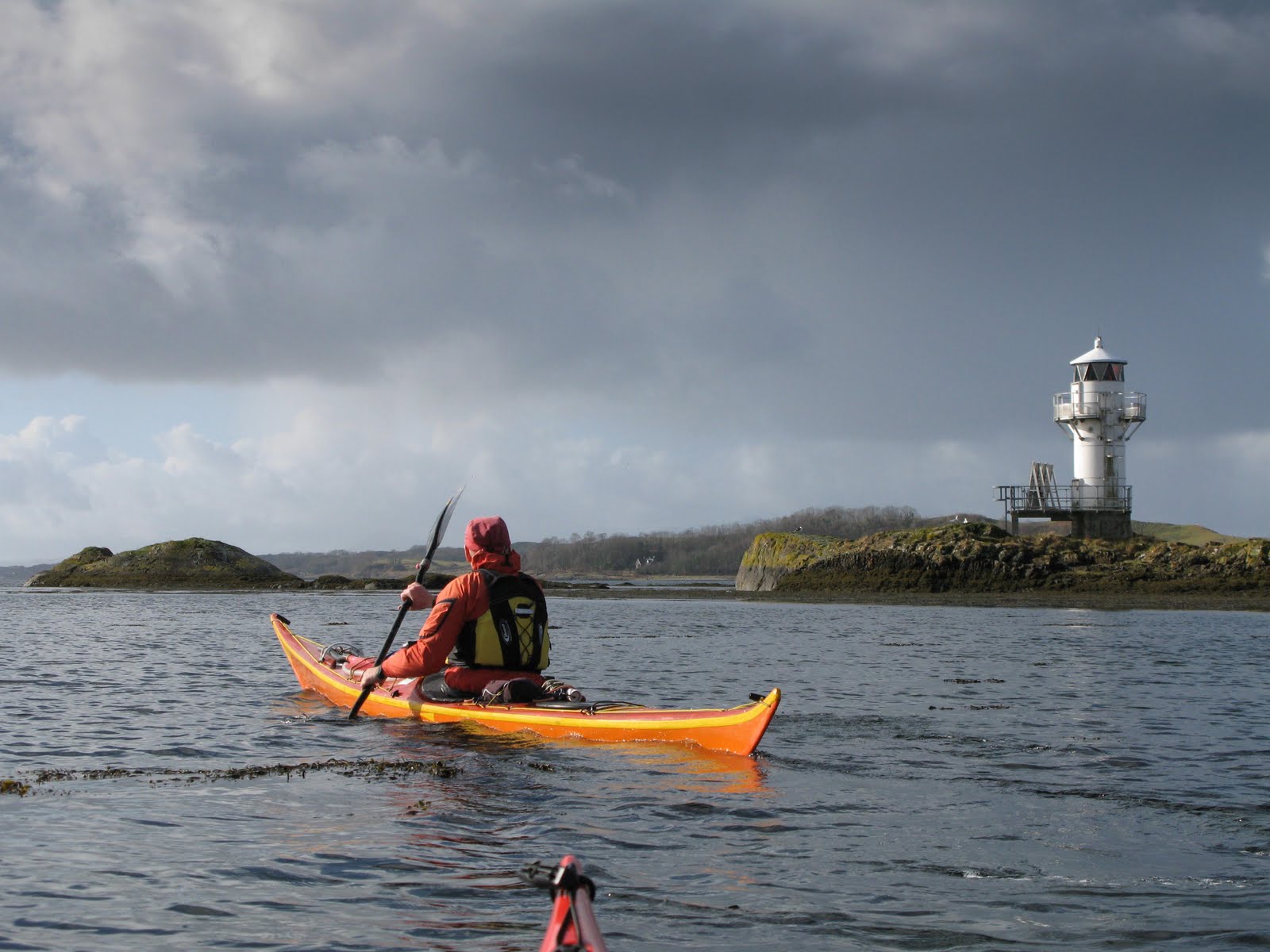
Sunday, 8 November 2009

A Flash of Inspiration

The Great Orme Lighthouse

Stu wouldn’t let on where we were going. North Wales, perhaps? Or Scotland? To keep up the suspense, he mischieviously did a couple of laps of the M6 roundabout. We took the south exit, and so at least that was a clue.

To cut a long story short we ended up at the seaside. Skirting through the well to do areas of Llandudno, though, I still couldn’t guess where we were going. The road snaked out onto the limestone shell of the Great Orme, winding high above precipitous cliffs. And then a faded red and gold sign pointed to the Great Orme lighthouse, now a most unusual bed and breakfast.

An evocative mix of antique wood and diving helmets: the inside of the lighthouse

A perfect antidote to modern civilisation, the Lighthouse hasn’t really changed much since it was built in the late nineteenth century. Not a traditional stripey tower, it is instead a T shaped, turreted limestone castle with the lamp room perched high above a three hundred foot drop to the sea.

Inside the old telegraph room, we watched all 280 degrees of sky turn from bright blue to gold as the sun set. It couldn’t have been a better way to spend my 40th birthday.

Door near St. Tudno's Church

Thursday, 22 October 2009

Once Around The Island

Sea Kayaking Round Milos and Kimolos


Another bright blue day was dawning on the Greek island of Milos. Things were ticking along as they have always done. There were familiar faces drinking the same drinks at the same bar tables. Just a little bit more leathery than six months before. Archontoula's beaming smile at the delightful taverna in the Plaka was just as it always was, and Katharina was opening up the fishing tackle shop across the road, just like before.

Six months had passed since we’d left this wonderful place, and it was as if life on the island had been frozen in time, giving the illusion that nothing had changed, or ever will.

The old Sulphur Mine

This timeless magic rests everywhere on Milos. But this time, everything inside felt different. Stu and I were meant to be joining one of Rod Feldtmann's sea kayak expeditions to circumnavigate the 120 km coastline. But just hours before the flight, Stu had to finally admit that his back was too painful to last the journey there, let alone the kayak trip. It was a dark tunnel that lead me onto the plane on my own, but it was pointless for both of us to back out. And in any case, I needed the experience, to be happy in big waves. Then, Olympic Airways went bust a day or two before, abruptly severing the airborne lifeline to the island.

Udo, Hellen and Sandra

As the collection of Dutch, German and British kayakers thumped down their hefty packs outside Perros’ bar in Triovassalos, we compared stories of trains, planes and automobiles as Olympic Airlines sputtered to a financial halt. No matter, we were here now, and were about to enter a new world, a reality almost untouchable by the hasty demands of the modern world. A place of few things: just the five elements and only the instant of time occupied by the here and now.


The Taste of Salt

It was fascinating to be fully immersed in this salty existence. Washing everything from dishes to clothes to ourselves in the sea. We all slotted into a deliriously simple beach life camped on the shore. How easy it was to wash dishes with salt water and some sand. And occasionally, an octopus would come over and lend a tentacle...(or eight).


It struck me that although we were tired, we were all happy. It was physically demanding, but a kayak full of gear was all we needed. Maybe the good things in life are not things. And everywhere, in everything, the taste of salt.


Blazing Paddles

For the first half of the trip, winds were light and the sea state pretty calm. As we rounded the south west corner of the island, though, the influence of the highest mountain started to come into play. Great downdraughts came steaming down the mountainside and onto the sea at near-gale force. Kayaking from bay to bay and out onto these Force 6 and 7 winds screeching around the headlands was a lot of fun. Like being pelted with a water gun at point blank range. Rod carefully edged us onward, one bay at a time.

Rod having a play in a Force 6-7 offshore wind

Then the sea began to roll. A two metre swell reared up, and I was about to get the experience I needed. We all were.

Christian enjoying the big waves at Cape Vani

From our little rainbow coloured kayaks, these were immense salty blue hills, settling out to about Force 5. But a funny thing happened. We all just got on with it. Terry started singing sea shanties in his flawless bass-baritone. Some of us joined in. Rod shouted us clear and concise instructions. We carried them out as best we could. To our surprise, and delight, we all found we could 'do' big waves. And even enjoyed it.

Sheltering from the storm at Sikia

A few days of being very alive in big waves and we had completed the circumnavigation. It had been tough, but fantastically good. We'd lived at sea for a whole week, and having completed this thing so much bigger than ourselves, we were happy.


Taking off in the Olympic Air plane, the land and sea tilted at a low angle and the diamond bright church at the top of the Plaka was glinting through blue sea. The scattering of white hillside houses hid Archontoula and her perfect taverna and the open door of Perros’ bar. Low down to the sea in the brightly coloured toy box boat houses of Klima, the salty cats were plumping up nests of sea grass before settling down for a sleep. The sea was sucking in and out of the rocks, and in the immense, sheltered bays, the wind shaving corners off the ashy cliffs. The light was breaking through the clefts of rock and into the endlessly writhing sea below. All of this life, this nature, shrinking to a fleck of land in an ocean of time.

Christian, me, Udo, Hellen, Roger, Jude, Marjolein, Sandra and Terry (photo by Rod Feldtmann).
_________

Expeditions are always quite intense experiences, and it’s been hard to settle back into what we like to call ‘normal’ life afterwards. But sometimes it’s hard to know what is real and what is unreal. For a short time, that mythical unreality, that life in a salty blue bubble was as truthful an existence as we could experience. Those mornings of Force 5 and 6, the rolling of the Aegean swell, that was living nowhere but in the moment. That was surely about as real as it gets.

Photo by Rod Feldtmann

Tuesday, 29 September 2009

Three Triathlons and a Mountain Marathon

Penny and I at the start of the Rab (photo courtesy of Jon Brooke, www.rightplacerighttime.co.uk)

It's been a crazy but fun month of doing big things. Thanks to a slip of the mouse on one or two online entry forms, I had been looking sidelong at September with a slight sense of trepidation. Most of that was down to one thing: the Helvellyn Triathlon. Not an event for the faint-hearted, it is a mile long swim in a cold lake, a 38 mile bike ride over Lakeland passes at their lung-busting best, then a 9 mile fell run to the Helvellyn ridge and back.

The other things were really just sharpeners, diversions from the main event. A sprint distance triathlon in Penrith and a club-organised tri in Appleby. And of course, there was the Rab Mountain Marathon.

Organised chaos in the transition area

But anyway. Back to The Helvellyn. The swim went like a breeze. The course was shortened a little as the water temperature was a bit low- any cooler and it would have had to be cancelled. And then from the drunken shadow-boxing out of the wetsuit, it was the long bike ride. If anything, this was the thing that drained the tanks, left the legs aching and crampy. But still, fascinating way to get that exhausted feeling without spending hours and hours on the hills...

By the time I'd got rid of the bike, everything from the waist down was in some kind of pain or cramp. It was an incredible feeling to know that 9 miles of mountain lay between me and a rest. As I hobbled those first few hundred metres while the legs adjusted to the run, Gill Douglas ran along side, as she had done for all the Arragons Cumbrian Triathlon Club folk. Before dropping back at the end of our one-sided conversation, she said '...just believe...'


These four events were a bag of chalk and cheese, as different from each other as they could get. The triathlon is a fun thing but it is, deep down, a contrivance, a fun thing to do with some fitness and a lot of equipment, but certainly a man-made game. The mountain marathon is different. It's about being absorbed into the mountains, going, as they say, where few men (or women) have gone before...

Penny on the Rab Mountain Marathon, the Howgills


The Rab was in the Howgills, those resting elephant-backs covered in a soft grass like the scruffy fur on a Border Terrier. They are, on any day of the week, some of my favourite hills to run in. It was a fantastic experience to spend two days running through them, slogging along sloping contours and into remote valleys where the situations were as grandiose as I'd seen on the LAMM in Scotland.


Perhaps the joy of mountain marathons is the sheer simplicity of knowing all you have to survive for two days is on your back. It's the kind of event where the mental and physical sides meet up, and if either one is not up to it, the game is over. To maintain the level of concentration needed while the tides of your mental state ebb and flow over two days is to slowly understand what you're capable of, what can or can't break you, and underneath it all, to perform a simple test of the spirit.


6.30 am, Cautley Spout

A glimpse of the English Schools Fell Racing Champs at Sedbergh


It's been a rewarding month of stepping onto the plate, and asking some big questions of myself. Give or take the odd moment of doubt in exhaustion, the answers have been positive. Chalk and cheese they all might be, but somewhere underneath it all, Gill was right. It just boils down to what you believe.

Tuesday, 22 September 2009

A Traditional Lakeland Show

Cumberland and Westmorland Wrestling with the fells as a backdrop

Ever since moving to the Lakes, I've managed to miss every one of these shows. Sometimes it's a straight toss up between running some race, kayaking somewhere or the gentler pursuits of taking in a show. And last year, many were cancelled because of the monsoon season.

Kicking back after the third triathlon in as many weeks, we finally got it together and went to the Shepherd's Meet and Sheep Dog Trials in Rosthwaite, Borrowdale.


Having spent a lot of time at Welsh shows, it was great to see the Lakeland version, with the unique and hopefully never fading sports of fell racing and wrestling.

Billy Procter and the lads from Helm Hill on the start line of the Dalehead Fell Race

The Mind Game

The biggest attraction was the wrestling. The crowd, three or four deep on all sides, first stood mesmerised by the junior matches. These were usually over pretty quickly and all a question of body mass. The older lads treated us to more tactical mind games which could have gone on forever...more stalking than wrestling. Great stuff.


All of these things, the sheep dog trials, the shearing, the droving skills, right down to the walking sticks are for me just one or two generations in the past, and the vestiges are still somewhere, languishing in the blood. Everything except the wrestling. And Stu rather pointedly said I might be quite good at that....

Trail hounds have an intensity about them that is often rare in other breeds

Duck driving

Thursday, 17 September 2009

Heartland


The Llyn peninsula is a singular place. Almost cut off from the rest of Wales, it has all the hallmarks of being an island. And it almost is. The landscape here is deeply rooted in the past, both primaeval and more recent: from ancient iron age hill forts to deeply gouged opencast mines.

Kayaking off here had an intangibly magical edge to it. Perhaps it was because of the bright blue sea, the warmth of the sun and the wonderfully rugged coastline. Or maybe it was the faint sizzle of belonging to this place. Not by birth, but by the far less obvious ties of ancestry.


In any case, a great place to paddle, often overlooked in the race to the tidal funspots of Anglesey.

A seagull feather on the water

_____________

From the vantage points of Snowdonia, a ragged line of perfectly peaked hills forms the backbone of the Llyn peninsula. Known collectively as Yr Eifl, these have been the mythical far off distant hills of my childhood, always there, yet never explored. Running through them was a dream made real in the bright blue sun of last weekend. Not vastly high, or remote, but learning now to expect the unexpected, they provided a surprise that took my breath away.


Around the summit of Tre'r Ceiri is an iron age stone rampart that encircles something like 150 ancient, perfectly built huts. High on this hill, with views stretching out over the sloping green baize and sea below, was an ancient community still preserved almost intact. All that was missing were the straw roofs and the palls of peat smoke. Was it amazing that this place still existed? Or was it that I had never heard about this place before?


It's so common to see hill forts dotted on the map but barely find a stone or two to mark their place in history. The complete picture of this place, by contrast, simply rises out of the ground. The huts are arranged organically like honey comb, drawn from the heavy scree into beautiful shapes. It is an amazing place.


Saturday, 29 August 2009

The Long Way Round to a Sense of Quietness


Sour Milk Ghyll gearing up for the rainy season

Sometimes, the best laid plans just aren't meant to happen, and as Rabbie Burns aptly pointed out, go 'agley' (whatever that means). Often, as Rabbie said, you're left with naught but grief and pain, but sometimes, maybe, a sense of peace and stillness can break out where you least expect it.

It went fairly 'agley' for me recently on a run round the back of Blencathra. I'd carefully planned an elegant but simple loop for the day, ending on the mighty track of the Cumbria Way. It didn't take long to realise it wasn't going to be straightforward, as the wind picked up and repeated storms flashed over and over. I was, in defiance of the weather, wearing too little. Breaking in some new fell shoes was another distraction from the real point of the run. And most irritating of all, the fells seemed to be coated ankle deep in moving sheets of achingly cold water.

To cut a long story short, I never made it even half the distance to my intended destination. Relief at reaching the river Caldew and the lovely Cumbria Way path just beyond it was dashed as I saw what the river had become. It was huge, and erupting rhythmically into big, brown standing waves like the backs of roaring bears. Dangling a leg in to see what it was like, I knew I had only one choice. Run round, or be mangled trying to cross it.

It turned out to be quite a long way round. The going was tough without real paths and with all that sheeting water. This was clearly the road less travelled as I eyed the alluringly- smooth track just a few metres away, beyond the Zambezi in full spate. But I did come across a beautiful badger's sett on this unpeopled side of the river, and felt little clouds of stillness rise up from the reeds.

After a few miles I was able to cross the torrent at a bridge, and ended up at the beautiful Lakeland hamlet of Mosedale. The day might have gone a bit 'agley', but having been forced to follow the Caldew all the way to its resting place on the flatlands, I had been tipped out of the fells at the Quaker Meeting House. Open for tea and cake, it said. Muddy, scratched and not a little bit damp, I sat on a pew and drank in the sense of immense, timeless peace.

Over a pot of tea and slice of cake, I listened as the lady at the urn recounted tales of entire trees being swept downstream, and once, her hen house. And in between conversations, the walls oozed stillness. Four hundred years of thoughtful meditation. I walked out of there a little different from when I went in.

Would I have felt this if my day's journey had been an easy run, predictable, planned, and executed to the letter? The answer is, I just wouldn't have got there at all.

Brass rubbings inside the Quaker Meeting House, Mosedale

Sunday, 16 August 2009

The Missing Queen of Inchmarnock


Inchmarnock is just one of those places. The sort of place that captivates and beguiles with a past so outlandishly interesting that you just have to go there. And we're certainly not the first sea kayakers to be lured by its charms. But, as is often the way, our visit to this tiny, teardrop shaped isle was anything but predictable. And this only added to its fascination.

Up till lately, Inchmarnock's claim to historical fame lay in the bones of a Bronze Age Queen found lying in a cist at the north end of the island in the late 1950's. The owner, Lord Smith of Kelvin, had placed a glass cover on her final resting place so that she could be viewed- sparking the curiosity of many a sea kayaker looking to unravel the fourth dimension. In the last few years though, the mystery deepened. The Queen somehow just disappeared. Douglas Wilcox wrote to Lord Kelvin to ask what had become of her, and his wife's reply, though courteous, gave no clues. She assured Douglas that everything would be explained, but stopped short, leaving us all hanging in space.

Having made it to the island, we found the open cist heaving with blackberry thickets and hoofmarks. We seemed to be no closer to answering the questions that surrounded this vivid reminder of our deep past. Settling back to an evening of watching the gannets plosh into the still waters, we saw a motorboat approach our end of the island. The two men on board stopped the boat at the beach and wandered up to the tent. I assumed this was not a welcoming party.

After fearing the worst, we were pleasantly surprised to find that the two men had just come to warn us about the Highland bulls- very excitable at this time of year. Whilst they didn't ask us to leave, we didn't need much persuading to relocate the tent to a safer spot. The boatmen turned to go, and I seized my chance in a split second. I enquired as to the whereabouts of the Queen.

In a great display of Scottish understatement, one of the men said "She's away just now". The older man was more forthcoming. He explained that she'd been taken away for DNA testing and face reconstruction. And apparently, she wasn't very easy on the eye, didn't eat fish, and was very local. We talked about the other archaeological research going on on the island, and his parting words were "you could work here for 25 years and still be finding things".


The Hostage Stone, depicting a Viking raid

And so it seemed. Farther south near the site of St. Marnock's chapel, an early Christian writing school was unearthed, with tablet after tablet of inscribed slates in Ogham and Latin script. The most extensive find of its kind in Scotland.

The cows found us a little after 11 pm, and started baying and pawing at the ground. They were curious, highly intelligent, and a little feisty. By morning, a thick clod of hairy beasts was peering dimly through Irn-Bru coloured manes at us as we attempted to make a dash for the kayaks. They were not the problem as such, but one of them was baying constantly for El Toro to help them out. In due course, the rippled black silhouette of a perfect bull in characteristic stance thundered up and screamed to a halt. After a few slightly tense moments, he collected up all his cows and calves and pelted off into the undergrowth.

The last inhabitants of Inchmarnock left in the 1980's, and it is now the home to the excitable hairy beasts. It would have been a complete paradise, as the last inhabitants still remember. Wandering through the ruined farm at Midpark, I found drifts of mint, angelica and medicinal herbs surrounding orchards of old fruit trees protected by tumbling walls. In the Queen's time, the island would have been lush, fertile and tree covered. It is extraordinary that she was preserved in her completely airtight cist for three and a half thousand years, just one out of many that escaped the attention of scavengers and grave robbers.

With the mystery of the missing Queen solved, we left the island to its hefty cows.

Saturday, 15 August 2009

Running Mad on Arran

The bunkhouse shoe collection

A few Eden Runners were up on Arran last week for a spot of bog trotting...and what a week it was. Amongst turbid and cloudy skies, the tumbling granite peaks arranged in wonderful horseshoes, the world was our oyster...almost. The weather played a blinding hand though, leading us on to thinking the worst on days that turned sunny, then luring us onto the tops in hideously wintry conditions.


Leaving Beinn Tarsuinn

Never mind this though. Arran is a place to come back to, to plan further runs, glen to glen. The sense of drama on the granite tops, weathered into cartoon mountain shapes, is fantastic. A mountain paradise.

The beautiful ridge of A Chir.

Running melded into scrambling amongst the boulders and ridges on the high peaks of Arran. Not for everyone, for sure, but for us, a gift.


Glen Sannox

Gill on the fast descent into Glen Rosa

Happy donkey, Glen Rosa

We need a holiday to get over the holiday- for us a full on, high octane mountain-fest of fun with friends. However varied our individual ambitions for the holiday were, I think we all had a scream of a time.

Friday, 31 July 2009

Kilmartin


Spread out a map of southern Scotland, and you’ll notice something quite subtle, but amazing. You might not see it straight away, but gaze at it with your eyes half closed, you’ll begin to see a dizzying number of cairns, standing stones and cup and ring marked rocks. These sentinel reminders of life thousands of years ago weave into a vast landscape of time, ritual upon ritual, eclipse on eclipse. In some ways, we have such a better grasp of space than we do of the expanse of time. But maybe in places like this, they become intertwined.

No where is this clearer than in the prehistoric landscape around Kilmartin at the end of Loch Awe. The terrain here is fairly typical of southern Scotland-hellishly lumpy and scrubby, yet fertile. What sets this place apart is that here, burial sites, astronomically arranged standing stones and circles are spread over the valley floor. Laid out in a vast sacred space, the effect today is dramatic and evocative. This landscape is probably no more special than any other in the area, but having lain under a protective layer of peat for hundreds of years until the 1800’s, the preservation is exceptional.

From Kilmartin, the glen spreads out like a heavy carpet, rucked here and there by ancient hill forts like Dunadd, the ancient capital of the kingdom of Dalriada. A landscape where time is as important as space.


Over the years, we've drifted out of the kayaks into lochside church grounds, and almost by accident found an uncanny number of ancient, beautiful carved stone grave slabs. These at Kilmartin church are some of the oldest in Scotland. Walking into the simple stone building was to feel a strong sense of gravity.

Later, I went for a run past cup and ring-marked stone slabs, their edges fringed with lurid green moss. Beyond, I turned right onto a singletrack mountainbike trail, then side-stepped back onto forestry roads. More track junctions came and went, and by this time I was turning mostly at random. On the right was a steep hillside recently felled of trees. In this wasteland there was a steep, rutted path roughly cut out with a digger and I took it. By the time I got to the top of the hill, it was about time to turn back. But as I did so, something caught my eye. About 30 metres away, a pointed gable end of a grey rock bent out of the wasted stubble.

I had stumbled upon another ancient site. It was part of a stone circle, surrounding a solitary chambered cairn, floating in a sea of flayed ground.

There's probably no magic or mystery to this. But maybe, just under the surface, there is a thin line that leads us.

Sunday, 19 July 2009

Three Days, One River


Wednesday night: Eden Runners club run

Round the back of Mosedale, the River Caldew slices through the bog and bracken on its way to the flatlands to the north, draining Skiddaw in the process. In spate, it is fast-running and broad. During the dry spells, it is flat, glittery and littered with stones like the true Highland rivers of the north.

Anticipating a gentle shuffle up along the path to Skiddaw House, I got swept along on a rather more purposeful journey: to find The Broxap Boulder. Known to a select few (or perhaps everyone but me..), Andy Sharples offered to point out the whereabouts of a boulder that allowed you to cross the Caldew 'without getting your feet wet', a secret imparted to Andy by Jon Broxap.

This stepping stone on Leg 1 of the Bob Graham Round took a bit of finding. Launching into tussock, then whipping heather stalks, we aimed roughly at the river. After some slewing back and forth, and with, it has to be said, dripping feet, we found the boulders. We bounced back and forth across them to prove, rather forlornly, that we could cross the river without getting our feet wet, then trudged back out along the little swathe through the heather carved by the feet of the few.

Back at the cars, I threw myself into a roaring plunge pool in the River Caldew.

Thursday morning: a recce of Leg 1 of the Bob Graham Round

The first leg of the Bob Graham Round, for those who don't know, takes a U-shaped course over first Skiddaw, then Great Calva and up the great broad back of Blencathra. These three immense climbs make up the 5 or 6000 foot or so of ascent on this leg.

The July monsoon season had started again. Thick blankets of cloud held Skiddaw’s grey top as the first rains thundered in on the wind. I scooted down the back side of Skiddaw into the cloud and got out the compass. There is a wonderful mathematical simplicity about moving on a compass bearing. A complex life form being guided by a few spinning atoms of iron. Distance, speed and time in a white darkness of clouds.

Moving up Great Calva's vast flank, a poem by Rumi on the iPod made me jump:

"...Keep walking
Till there is no place to get to.
Don't try to see through the distances
That is not for human beings.

Move within,
But don't move the way fear makes you move.
Move within..."

With these longish runs, you can slowly prise back the tightly bound leaves of what the brain thinks the body can withstand. It's a good thing to do.


Friday night: light support of Cathy Gill's Bob Graham Round


At the age of 17, Cathy Gill was attempting to be the youngest woman to complete the Bob Graham Round. I'd offered to help by running into the notch between Skiddaw and Great Calva with some soup with her mum and sister, Dawn and Jane.

Only things weren't quite as they should have been. First and foremost, the weather was unbelievably bad. So bad that nobody really knew whether it was sensible to even start. And Dawn was so ill with the 'flu that she should really have been in bed, not standing in the middle of Keswick in the thundering rain.

Cathy Gill and Stuart Hurst on Leg 1

Dawn was wearing the accumulated anxiety of a mother about to watch her daughter set out on a 70 mile run across the mountains along with a bout of flu in the time of an epidemic. She handed me an enormous tub of soup, then a few bottles of water.

We set off, not quite sure whether we'd get there in time.

'I wonder if we'll make it in time' Dawn whispered, in concerned tones. A little later, she suggested that we start running while she walked behind...

Janey bounced off, unencumbered by the burdens of either age or soup. I thought about mentioning that I couldn't run with this much weight, but started shuffling anyway. It seemed to work, so I kept going. Soon, I was running with eyeballs out, stupidly trying to catch up with Jane. The path had become a river, and plodging through it, I remembered that I had gulped down too much tea in the anxious moments before Cathy's start, and now needed to go to the loo. Still, there was no time for that if the soup was to arrive.

We did indeed get to the crossing point just in time. Cathy, Adam and their pacers were as wet and slick as seals, while the rest of us sherpas just looked drowned. After a few gulps of soup, they were off into the mist, and we traced our steps back over the Caldew, one more time.

The pacers taking a breather

Running back to the car, the Glenderaterra River was spewing for its entire length at angry fire hydrant strength. The Caldew would be an immense, brown torrent by now, and even the Broxap Boulder would be engulfed.

_________________

In the conditions, Cathy and Adam did amazingly well. Cathy had to retire at Dunmail as the wind and rain on the Helvellyn range had worn them down. Adam continued on to Leg 3 but also had to give in to the weather eventually. Cathy has already started planning another attempt in August.

Monday, 13 July 2009

Quite a Day in the Lakes...


The relief is palpable- coming in to land
Photos by Stu Mair

Sometimes it's quite good to do something that you're thoroughly unprepared for: and the one and a bit mile swim at the Day in the Lakes Triathlon fitted the bill there quite nicely. With the number of serious open water swims stretching onto two fingers of one hand, I really was wondering whether it would be sink or swim.

As the swim wore on, though, there was a massive sense of relief to realise that it was going to be ok. I'd survived a fairly decisive clip round the head and one quite impressive headlock from other swimmers, but other than that, it was plain sailing.

Sunday, 12 July 2009

Borderlines


There are those times when it's wet and windy outside, and there's nothing for it but to wheel out the mountainbike. It's a fill in for us. A way to walk out the door past the beckoning vacuum cleaner and make the most of a marginal day.

Here and there, we've visited all of the 7 Stanes of Scotland, and a smattering of other mountain bike trail centres besides. Each of the 7 Stanes though, have a unique identity. In amongst the miles of tracks, somewhere, there's a stone. Doesn't sound much, and to most of the mountainbikers there, it probably means very little.


At the Scottish border with England, the sculpted stone at Newcastleton is inscribed with Rabbie Burns' Auld Lang Syne to the north and Jerusalem to the south. Some of the other Stanes are perhaps more subtle, esoteric even. There's one shaped like a Pictish arrow head and carved with runes. Another inscribed in Klingon.


Perhaps the symbolism of this stone is fairly obvious. But for some reason, I really like it.

Sunday, 5 July 2009

Slate, Sea and Sky

Sea Kayaking off the Atlantic Isles


The desolation of Belnahua

Going in search of that magical blend of beauty, melancholy and wilder-than-fiction myth that jumps out at you on the Scottish Isles, we ended up on Seil and Luing recently.


Tip-toeing through first mist and then thunder and lightning, we made it to the deserted quarry township of Belnahua. A tiny dot of land, half corroded and eaten by years of slate quarrying, it is surrounded by a tidal mash of currents slewing through tight narrows of land and scattered islands.


It is a surprising place. This is all old slate quarry, but it is like walking on pillows. A deep machair has evolved over the 100 years of human absence, and as you walk over its unexpectedly uneven man-made surface, it is deeply plush as thick down. Things appear out of the grass. A winding mechanism. A mechanical pump. A series of channels for water to escape into the ocean.


Nature is slowly reclaiming the hard slate back into a soft island again.


Cormorants on misty skerries


Sometimes, it's easier to piece together the history of a place by visiting a graveyard than it is any museum. And Luing's ruined chapel at Kilchattan is no exception. There, in the stillness, we found the slate quarriers, founders of Presbyterian splinter groups and the Latvian sailors shipwrecked off Belnahua in 1936.


Only there for a day or two, we sank a little into this place. In the village shop, it took moments for us to find out that someone we knew lived in the village. Later, we asked for some water at a nearby house. 'Oh, you'll be the kayakers then. My husband's been watching you with the binoculars all day. He said you must know what you're doing because you hit the tide just right...'

Friday, 26 June 2009

If...

Ian Charters' 55 peaks at 55


On 13th June, Ian made his third and final attempt to complete an extended round of 55 Lake District peaks in under 24 hours. Having completed 51 of them in September last year, it was a fair bet that if conditions were perfect, he could make it.

Ian was on bang on target coming into Wasdale as I stood in delighted disbelief at once again being in the company of Jos Naylor. He had arrived in David Powell-Thompson's Subaru, perhaps more mobile office than means of transport. It was stacked, layer upon layer with first paint spattered tools, then dog-eared and yellow books on the history of the Duddon Valley.


Jos, David, Ian, Alistair and my arm. Photo by Pauline Charters

As the time came for Ian, Colin, Alistair and myself to leave Wasdale for Dunmail Raise, Jos fixed Ian with his timeless, raven-like stare. 'Now don't give up, lad... however hard it is...' he said, gravely, and you knew Jos had been there, lived those long hours of pain. A salvation through suffering that Ian would relive again, one more time.

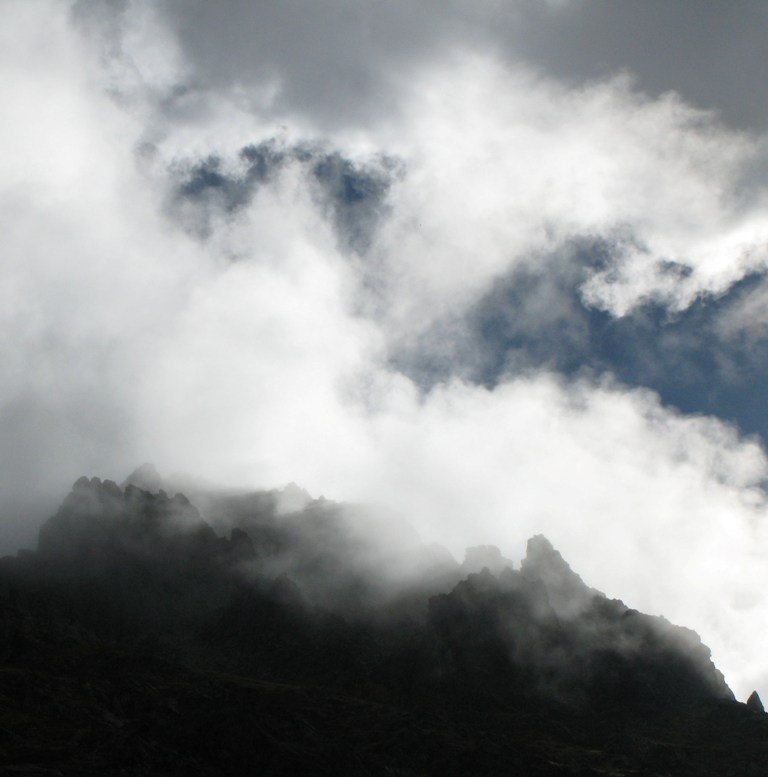
In the shattered landscape of the Scafell massif, the light flicked on and off through fast moving veils of low cloud. The rocks turned intermittently gold and grey as the sun went down, and the atmosphere was electric.


The sun eventually disappeared, and the wind dropped. This was a heady, charged silence to be running through in the dot-light of a head torch. Hour after hour of black silence and mountain, and then the single melodic warble of a skylark.

Ever so slowly, time had been trickling away as each black peak came and went. Ian had been feeling sick, and wasn't able to eat enough. And the gut wrenching moment came when he called it a day, after something like 18 hours on the run.

Looking in on the sidelines of these long distance attempts, it is hard to really understand what it is like, how much you really have to put in, and what it takes out of you. Being part of a support team, you invest a little bit of yourself, and add your hopes to the heap. So we all felt for Ian when he made this tough decision.


It would be easy to see only disappointment after this, but that would be just half the story. So few people dare to contemplate such extended rounds, let alone in their most unforgiving and committing original versions. So few are prepared to give what it takes to try.

It was not the outcome that defined the level of Ian's achievement, but what he chose to measure himself by in the first place. And for the experience of running through mountains with Ian and his friends? I think we are all the richer for it.

Sunday, 21 June 2009

A Party in the Forest


Beside a perfectly built Celtic Roundhouse, the band played another impeccably executed tune. Without a word, a fire thrower moved into a space between trees.


A day to remember in a beautiful space, and a wonderful way to celebrate Pen and Al's future life together.