Wednesday, 10 November 2010

The Isle of Two Halves

Circumnavigating the Isle of Bute


The Isle of Bute nudges up against the deeply-rutted lochs of the Cowal Peninsula, and it is an isle of two halves. And in keeping with this double identity the Scottish Canoe Association trip in September saw us complete the circumnavigation in two very different days.


From the lozenge of land at the southern end, Kilchattan Bay, we launched into the trip. It had been a bit of a shock to find that (a) it was going to be a long, 60 km paddle around the Isle over two days, and (b) that Stu had decided to tactically withdraw from the trip to save his back for a climbing holiday we had planned. Stu had a pleasant wander round the Isle, meeting us at various landings, instead.

As we rounded the southern tip, our leader, Roddy MacDowall of Kayak Bute passed off the surprising, rucking waves as "just a wee but o' tide..." This half of Bute is rugged and rusty-brown, abutting the wonderful isle of Inchmarnock, where we stopped for lunch. From there, we were in sniffing distance of the fantastic cafe at Ettrick Bay, its over-sized lemon meringues a mirage to our salt-cracked eyes.

The glory days of the Clyde Steamers remembered in a weather vane

We camped next to Colintraive Hotel on the mainland just beyond the northern end of Bute and with a fantastic meal and great beer, it couldn't have been better.


Bute's other half is altogether a different story. The eastern side is dominated by Rothesay and Port Bannatyne, great Victorian holiday ports now slightly decaying and enduring the after-effects of Glaswegian resettlement policies of the seventies. A wonderful retirement destination mingled with surprising pockets of social deprivation and almost-urban levels of isolation, only moments from Scotland's great western frontier.

A weekend of contrasts, for sure, but having made it round, an experience to treasure.

Thursday, 30 September 2010

A Small Scale Delight


The Rab Mountain Marathon 2010, The Eastern Fells

The Mountain Marathon season has barely started for me this year, but if there was one event to do, the Rab was the one. Cool, but clear and dry conditions made for a stunning weekend of upland, off-piste running, and as always, there was the huge privilege of being in the mountains for a whole weekend. Liberated by the unbearable lightness of modern day kit, from super-lighweight tents to the humble zip-lock bag, we were in for a two-day journey through the mountains of the mind.

As Day 1 drew to a close, Penny and I were nothing short of confused. With our carefully calibrated piece of string, we had mapped out a route that should have stretched us in the six alloted hours of running. After five, though, we'd made too much progress, and were marooned between a distant checkpoint, high up on the steep slopes of Place Fell, and the lure of the finish. In the end, we opted to finish early. But as Kate of Tea and Cake has rather bluntly pointed out, if you stay out too long, you're crap, and if you get in too early, you're crap. I guess on that day, we fell in the latter category...

In any case, our string theory worked better on Day 2, and we squeezed into the finish with a few minutes to spare. Much more satisfying. And with a third place in 'the ladies of a certain age' team category, we were chuffed to bits.

Tuesday, 7 September 2010

The Longest Day

Bill Williamson's Ramsay Round

Bill and Ian on the climb up Stob Coire Sgriodain

In life, we all have our mountains to climb. But for Bill Williamson, there have been more mountains than most. A year or two ago, Bill made an attempt on the greatest of all Mountain Trilogies: the Bob Graham, the Paddy Buckley and the Ramsay Round. All in one year. With the first two of these in the bag, it was the Ramsay Round that remained elusive. By far the toughest of the big rounds, this 56 or so mile loop of Scotland's most challenging mountain terrain was proving a tough nut to crack.

Ian Charters and I were Bill's pacers over the least challenging of the Ramsay Round legs- a 17 mile run taking in a few Munros including the mighty Beinn Na Lap. 'Least challenging' is perhaps a funny way of looking at it though. The terrain is as challenging as you could find in the UK, and the degree of remoteness is breathtaking. Staring around the room in the Rucksack Club hut the night before, it positively radiated with Legends of the Fell. Yiannis Tridimas, the Zen Master of Endurance ("Your trouble, my friend, is you have a low tolerance of pain..."). Alan Lucker, veteran of the UTMB and a host of other self-effacing but miraculous ultra-distance mountain runners like Bill and Ian. Even the support crew were semi-professional (the eponymous Wynn Cliff). I wasn't sure I could keep with Ian and Bill on the day, but in reality in this remote environment, there really would be no choice.

Charlie Ramsay and Yiannnis Tridimas

At the start of Bill's run, an engaging figure introduced himself as Charlie Ramsay. He'd taken the trouble to come and see Bill start, and, as with most central figures in the sport, turned out to be captivating and enthralling. It was a rare privilege to meet Charlie.

At six in the evening, Bill rounded the shores of Loch Treig where we met him for the next leg. Bill was in great shape and although the weather closed in shortly after getting up high, things were going well. The descents were tough, though. With head torches on, it was almost impossible to judge whether you would be landing on stone (hard), heather (disarmingly springy) or jet-black, still, leg-munching runnels full of icy water (which claimed a leg from each of us). It was best just to slither, and fast.

After the long, wet run through bog-lets and rivers, the wandering trace of a headtorch signalled that we about to deliver Bill to Yiannis, Will and Alan for the next leg over the Mamores. It was looking good- Bill had navigated impeccably and was very sharp despite deteriorating conditions. As the two Ians, Pauline and I took the low road for the 2 hour walk out, the wind started to pick up, and the rain slashed down.

After the crushing doubt of the previous day, I woke refreshed after a mere 3 hours sleep. But it had been heaving it down all night. For a while we pensively waited to hear news of Bill's arrival, but as the minutes ticked away, we knew. The weather had beaten him again.

Bill completed the Ramsay Round in conditions that would have flayed the lycra off most mortals. In those conditions, 26 hours was no defeat, but a shining example of mind over matter. And for me too, grappling with uncertainty and doubt in the foothills of the mind, it had been an unparalleled opportunity disguised as an impossible situation.

Monday, 9 August 2010

Round The 'Horn


"The sea is boring, like grief is
But beautiful, like grief is not"


Norman MacCaig

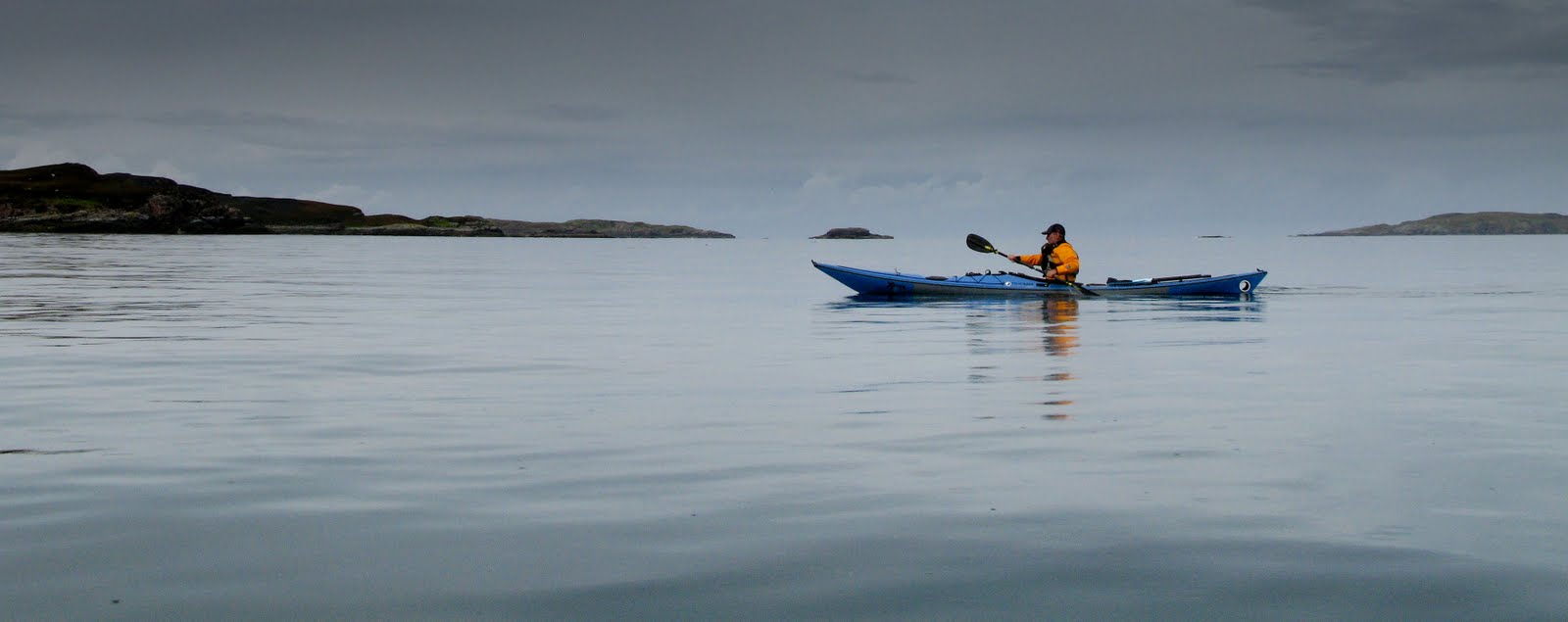
Sometimes, there is nothing better than a boring sea. Boring and beautiful. It is on days like these that the apparent exposure and infinite-ness of the sea is as comforting as withdrawing to a fire-side hearth. On the rare occasions when the sea is calm, predictable, it forgets who it's meant to be and becomes a balm to tired eyes.

Today, we are nosing in and out between rocky islets off the Isle of Whithorn and up to Garlieston off the Dumfries coast. Both fishing hamlets, quiet aside from the folk walking dogs and children along the rocky beaches. These are hamlets that time has forgotten in its race for sameness. The bar is still full of locals, characters, grumpy staff. Old men with faces chiselled by salt and wind still go fishing off the pier. And they still play bowls.


We haul up in White Port, a tiny cove that has no access by land. The fringe of tiredness has receded like the tide drawing lazily away from the kayaks on its planetary journey.


Later, on a run into the thick forests of Dumfrieshire, spotlights flashed in and out of the burn on its way to the sea. It seemed as if the forests were breathing out. It was warm, and there was a sense that they were steaming.


Rising out of the forests and on to the glens, I saw it. The trees were indeed exhaling.


The Solway coast up here on the Scottish side is always a delightful surprise to the kayaker. Tucked away behind unassuming, green, rolling hills, the rocks on the coast are upturned, and the sea is busy making islands, teeth and gaping caves. It's on days like these that it's great to be there, on the journey.

Thursday, 22 July 2010

On An Odyssey of Tides

The Farne Islands

To boldy go...

There is an old adage in seafaring circles that says the sea will always give the test before it thinks to give the lesson... and so it was on a recent trip to the Farne Islands. Sat just off the shore of the north east coast, these iconic islands have long been in the distant gaze. Impossibly close, yet impossibly far.

One of a thousand seals

At this time of year, they are the preserve of a million sea birds, nesting where there are no natural predators. It has to be said, this was a spring tide: the largest of the year, and few self-respecting kayakers of mediocre skill levels would venture to the Farnes knowing that the moon was in full swing. Here, the tides leap with some severity over the slabs of dolerite beneath the water to sudden waves, haystacked together. We should have known better, of course, but somehow, in the race to make the most of the good weather, the full moon slipped us by.

The racing tides around Megstone

With a Force 4 forecast we opted for a day of coastal pottering on the trip between Boulmer and Beadnell. The guide to kayaking off the coast here said there were no tides to speak of, so that was good. The faint waft of kippers rose on zephyrs of wind at the lunch stop of Craster and we resisted the urge to have an ice cream.
Sue approaching the Inner Farnes

Pressing on northwards, the wind picked up and something tide-like was running under the boats in the opposite direction to the wind. Wind against tide always creates a confused sea, but it was about to get worse. Much worse.

I was beginning to wish I'd had that ice cream.


On the horizon, there were hills of sea. Haystacks in the water. I casually asked Stu what he made of them, white heaps jumping erratically up into the froth. It conspired that the tide was racing onto a spur of dolerite extending from Dunstanburgh Castle out to sea. The haystacks were huge, and quite unpredictable. Before I could say 'I don't like the look of that', Stu had got sucked through it, fending off the white foam heaps the size of tractors with an alarming set of white water manoevres.


After a long afternoon involving a variety of transport methods, we were all back together, safe and capable of laughing about it.

The Farnes themselves presented us with some of the most unpredictable, beguiling seas imaginable. From the Kettle, flat, turquoise and bath-like amid the families of Arctic Terns, to the house-sized, crackling waves that leapt in a straight line from flat calm to immense in a single beat as we traversed the North Sea. A quixotic, alarming think-on-your-feet sort of place.

But this of course is only half the story. Having retrospectively learnt that lesson the sea threw casually sideways, there is one thing I know. I'll be back for another go. But next time, perhaps not on a spring tide...

Tuesday, 6 July 2010

Lismore by Kayak

A while back now, we spent a weekend with the Scottish Canoe Association circling the limestone isle of Lismore.

Nigel and his new boat

Sue on a graceful turn

The weekend was billed as a lazy trip around the isle, and with summer suddenly arriving all at once, it was hot, sultry and still.

Achanduin Castle

Lismore is tucked neatly at the mouth of Loch Linnhe where the back end of Mull starts to reverse into the mainland. For some on the trip, this was their back garden. And for us, it was another chance to experience the mingling of pasts with present, with landscape and forgetting that is to journey on the sea.

Camped near the southern tip of the island, the light was breathtaking

Gentle tidal smudging of the water at the southern tip of Lismore

Alison and the Kilcheran Isles


Shia, a ship's cat

Several of the people on the trip had moved from the city to live by these waters, to shape their lives around the daily tides. Undoubtedly, there are untold sacrifices in leaving behind the steady income of a city life, but it's a lesson to us all when people have the courage to follow their dreams. Mooring at one such home, one of the cats, Shia, joined us for the last leg of the journey. While we ferried boats from the water to the road, he checked the boats out, sniffed things and generally got to know everyone. I've undoubtedly spelt his name wrong, but roughly translated from the Gaelic, it means something like 'gentleman of the fairy grotto'.

Wednesday, 2 June 2010

The Selkie of the Summer Isles

Fading light over the Summer Isles

In Old Norse and Celtic mythology, the selkie was a half-woman, half-seal who was able to shed her seal skin to ensnare sailors, then return to the sea when she felt like a bit of a change. It's a myth that finds itself repeated in many countries from Iceland to Australia. In his book In Another Light, Andrew Greig points out that they might all have stemmed from the haunting, melancholic cry that seals sometimes make on lonely skerries far out to sea.

Out on a trip to the Summer Isles, we are threading a line between widely-spaced skerries towards the wondrous Priest Island. The Minch is but a thin, glassy channel between us and the faded blue Outer Isles in the distance. Twisted skeins of glassy, undulating ocean roll in deepening blue towards Priest Island and the skerries in between. In the open expanse, there is a kind of sensory deprivation. No smells, no wind, just a gliding motion. Maybe a tint of salt, perhaps. But arriving at the shore of a skerry, the overwhelming saline-and-fish smell invades the senses after the blue desert of the ocean.

Storm shower over Bottle Island

Turning the boats towards the next sighting point, it is silent and the senses are stilled again. Little wind, and the quiet rush of paddles in the water. Just two kayaks in the vastness of blue-space. Several hundred yards away from the skerry behind, we are arrested by a wailing sound. We look back, but there is nothing. This mournful cry is, presumably, a seal. The selkie of the ancient myths.

The sea is a remarkable place.


Jutting out of the water like broken teeth, the skerry of Stac Mhic Aonghais is fringed with cormorants. They seem to like to add a touch of drama to already gnarled sea cliffs. The northern side of this islet slants out of the water at an angle, allowing the sea to slew dramatically up its ramp-like face and back down into the blue in a whirlpool of banked-up water. The moment of magic came when we paddled into this furling stream: meeting a raw edge of sea at the edge of the world. It wasn't, of course, but for a moment, it felt like it.

The sea like glassy, rolling skeins

Uncannily at the same distance from the next skerry and miles from the last, the mournful wailing began again. A look backwards revealed nothing. Maybe the seals were just playing with us.

Amidst a clutch of cormorant nests on a cliff, the sea etches patterns in the rock like abstract art

Textbook storm clouds above Tanera Beg

Here and there, the sea is pockmarked with resting seabirds. Some of them came over to swoop us, including a massive Bonxie, the pirate of the skies.

Inside an abandoned boat

It's a privilege to experience the sea's daily tides in places as beautiful as this, and to glimpse the timeless magic of the selkie seals.

Tuesday, 11 May 2010

At The Water's Edge

Kayaking Round the Isle of Gigha


In the face of a another dramatic forecast of wind and rain over a typical Bank Holiday, we headed out to the Isle of Gigha. This rutted, linear scrap of land is shaped by the great tidal slew between the Mull of Kintyre, Islay and Jura. It had been languishing on our 'must go' list for quite some time, but had always been the casualty of raging winds or some other factor of a show-stopping nature.


Casting the serious and imposing forecast to the four winds, we went anyway. And good job too. In amongst the occasional Force fours, we picked our way round most of the coast, including the enchanting Isle of Cara.

A procession of wild goats on the Isle of Cara

Amongst these long, stunning paddling days, the coastal fringe changed with every passing bay: always interesting, diverting. Otters, herons, seals, and a pod of large porpoises. The porpoises came out of the blue as we were paddling over the last juttings from the sea of the Russian ship, Kartli.


Taking the adage of "women and children first" somewhat literally, Stu placed me and my kayak between himself and these large, mildly inquisitive superior beings. From their jet- fast transit across the bay, they effortlessly arced towards the kayaks, considered us for a moment, then carried on their amazing journey. They'd be at St. Kilda in time for tea, probably.


Most sources tell you that Cara is uninhabited. But there, next to a ruined chapel is an old Tacksman's house turned smugglers' den, which to some, would be a dream home.
Surrounded by no more than an impressively large herd of totally wild goats, all shaggy cream and brown, this island and its lonely house, all leather and white, parched maps, are wonderful.

Cormorants in the stillness

Sometimes it's sad to leave the unique quality that exists on these many Scottish islands, but it won't be forever. Standing at the water's edge, I was sure of one thing: that one day, we'd be back for more.

Leaving Gigha

Sunday, 18 April 2010

The Wacky Races


The 4th Ravenglass Seaquest

To some, this might be the stuff of nightmares: imagine you're running in wellie boots. Wellie boots full of water. You're also running through thick, estuarine mud the colour of chocolate. And as you run, the mud clings more and more, and the checkpoint seems to be getting farther away. Was this a bad dream? No. It was the Ravenglass Seaquest.

As races go, it couldn't be more wacky. Checkpoints dotted about in three different forked limbs of an estuary. Some of them might be floating, some on land. Some in mud, and some, it turns out, completely submerged under water...And the idea is to clip the most checkpoints in under three hours of kayaking as the tide shifts land to sea, and back again. In some ways, it couldn't be more intellectual. Which estuary first? Do you make use of the tidal jets as they force upstream, or do you plough right on?

Everything had gone beautifully to plan. We were ahead of a loose schedule and managed to clip most of the checkpoints with a few minutes to spare. We hadn't even had a flicker of a domestic, which can be an occupational hazard when racing in a team with your partner, and at the end, we'd had a great time.

Preferring the quiet patio of the pub round the back to the jostle of over a hundred kayakers on the sea front, we enjoyed a quiet pint in the sun after this fast- paced epic. On our way back to the car, we stopped for a moment at the prize giving on the front just as we were announced the winners of the mixed pairs event. We couldn't have been more surprised, and it did feel like a bit of a dream. But a good one.

Tuesday, 6 April 2010

Getting Away From It All


Loch Nah Achlaise, one of the most photographed Lochs in Scotland

I've got to admit, life has been racing away with itself a bit of late. What with one thing and another, we've both feeling a little drained. In the run- up to Easter, we had been watching the marine forecasts with half- amusement as they veered wildly from Force 2 to Force 8. Without much of a clue about which one to believe, we took the safe bet and opted for a few days of kayak- camping in Loch Shiel.

I found it hard to believe that any three or four day trip could extinguish the rush and haste we'd escalated into, but this is what happened. Pushing off the shore at Glenfinnan, that was the last we were to see of it...For a while, at least.


With half an immense trout packed carefully in the boat (the unfinished portion of a particularly fine b & b breakfast), we paddled off to camp in a large valley half- way down the loch. For the next few days, that was our peaceful home. The trout was lightly fried in butter and shallots, and with a few beers chilling in the stream, this was a silent heaven.

The western end of Loch Shiel

In some ways, this place was almost too quiet. Compared with the endless shifting dynamism of the sea, the estate-managed loch was quiet, museum-like. But perhaps this was what was needed. A minimalist place of contemplation. No boats, no people, only the view.

Pink Ears In The Graveyard

It was all change at the end of the loch, though. A tiny jewel of an island at the far western end had caught our eye. St. Finan's Isle, with a ruined chapel and graveyard.

Little Viking boat on the altar

Reaching the shores, we could see a Canadian canoe had already landed on the island. Fellow paddlers (about ten, in all) were slowly converging from the end of the loch, and we stopped for a chat. They were wearing pink, furry, rabbit ears.

Boat-prints on the shore

That's the wonderful thing about kayaking in Scotland. In amongst the stillness, there's always something funny, magical, startling.


The kayakers moved off to join us camping in the big valley, but in an instant in this big country, they were dots on the immense horizon. The chapel and graveyard were quiet again. It was hard to imagine how the magic had worked on us in such a short space of time, but once again, it had.