Wednesday, 2 June 2010

The Selkie of the Summer Isles

Fading light over the Summer Isles

In Old Norse and Celtic mythology, the selkie was a half-woman, half-seal who was able to shed her seal skin to ensnare sailors, then return to the sea when she felt like a bit of a change. It's a myth that finds itself repeated in many countries from Iceland to Australia. In his book In Another Light, Andrew Greig points out that they might all have stemmed from the haunting, melancholic cry that seals sometimes make on lonely skerries far out to sea.

Out on a trip to the Summer Isles, we are threading a line between widely-spaced skerries towards the wondrous Priest Island. The Minch is but a thin, glassy channel between us and the faded blue Outer Isles in the distance. Twisted skeins of glassy, undulating ocean roll in deepening blue towards Priest Island and the skerries in between. In the open expanse, there is a kind of sensory deprivation. No smells, no wind, just a gliding motion. Maybe a tint of salt, perhaps. But arriving at the shore of a skerry, the overwhelming saline-and-fish smell invades the senses after the blue desert of the ocean.

Storm shower over Bottle Island

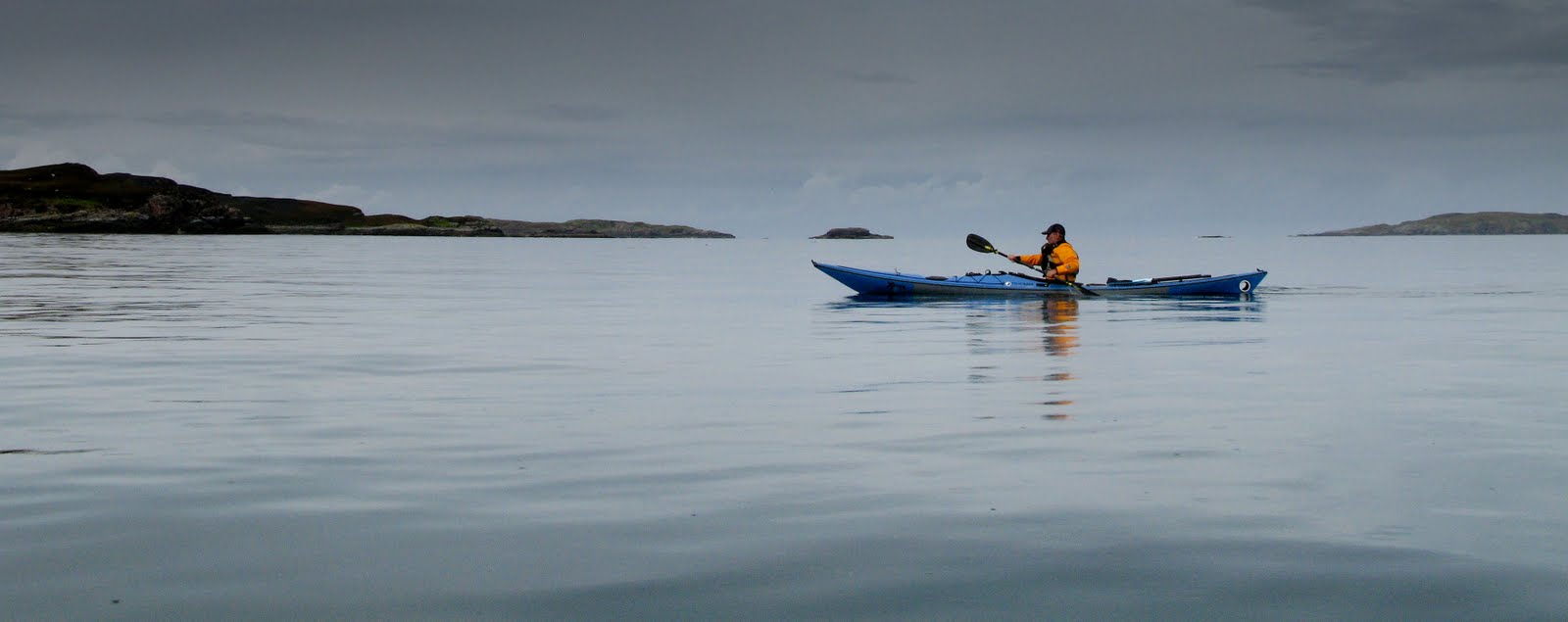
Turning the boats towards the next sighting point, it is silent and the senses are stilled again. Little wind, and the quiet rush of paddles in the water. Just two kayaks in the vastness of blue-space. Several hundred yards away from the skerry behind, we are arrested by a wailing sound. We look back, but there is nothing. This mournful cry is, presumably, a seal. The selkie of the ancient myths.

The sea is a remarkable place.

Jutting out of the water like broken teeth, the skerry of Stac Mhic Aonghais is fringed with cormorants. They seem to like to add a touch of drama to already gnarled sea cliffs. The northern side of this islet slants out of the water at an angle, allowing the sea to slew dramatically up its ramp-like face and back down into the blue in a whirlpool of banked-up water. The moment of magic came when we paddled into this furling stream: meeting a raw edge of sea at the edge of the world. It wasn't, of course, but for a moment, it felt like it.

The sea like glassy, rolling skeins

Uncannily at the same distance from the next skerry and miles from the last, the mournful wailing began again. A look backwards revealed nothing. Maybe the seals were just playing with us.

Amidst a clutch of cormorant nests on a cliff, the sea etches patterns in the rock like abstract art

Textbook storm clouds above Tanera Beg

Here and there, the sea is pockmarked with resting seabirds. Some of them came over to swoop us, including a massive Bonxie, the pirate of the skies.

Inside an abandoned boat

It's a privilege to experience the sea's daily tides in places as beautiful as this, and to glimpse the timeless magic of the selkie seals.

Tuesday, 11 May 2010

At The Water's Edge

Kayaking Round the Isle of Gigha


In the face of a another dramatic forecast of wind and rain over a typical Bank Holiday, we headed out to the Isle of Gigha. This rutted, linear scrap of land is shaped by the great tidal slew between the Mull of Kintyre, Islay and Jura. It had been languishing on our 'must go' list for quite some time, but had always been the casualty of raging winds or some other factor of a show-stopping nature.


Casting the serious and imposing forecast to the four winds, we went anyway. And good job too. In amongst the occasional Force fours, we picked our way round most of the coast, including the enchanting Isle of Cara.

A procession of wild goats on the Isle of Cara

Amongst these long, stunning paddling days, the coastal fringe changed with every passing bay: always interesting, diverting. Otters, herons, seals, and a pod of large porpoises. The porpoises came out of the blue as we were paddling over the last juttings from the sea of the Russian ship, Kartli.


Taking the adage of "women and children first" somewhat literally, Stu placed me and my kayak between himself and these large, mildly inquisitive superior beings. From their jet- fast transit across the bay, they effortlessly arced towards the kayaks, considered us for a moment, then carried on their amazing journey. They'd be at St. Kilda in time for tea, probably.


Most sources tell you that Cara is uninhabited. But there, next to a ruined chapel is an old Tacksman's house turned smugglers' den, which to some, would be a dream home.
Surrounded by no more than an impressively large herd of totally wild goats, all shaggy cream and brown, this island and its lonely house, all leather and white, parched maps, are wonderful.

Cormorants in the stillness

Sometimes it's sad to leave the unique quality that exists on these many Scottish islands, but it won't be forever. Standing at the water's edge, I was sure of one thing: that one day, we'd be back for more.

Leaving Gigha

Sunday, 18 April 2010

The Wacky Races


The 4th Ravenglass Seaquest

To some, this might be the stuff of nightmares: imagine you're running in wellie boots. Wellie boots full of water. You're also running through thick, estuarine mud the colour of chocolate. And as you run, the mud clings more and more, and the checkpoint seems to be getting farther away. Was this a bad dream? No. It was the Ravenglass Seaquest.

As races go, it couldn't be more wacky. Checkpoints dotted about in three different forked limbs of an estuary. Some of them might be floating, some on land. Some in mud, and some, it turns out, completely submerged under water...And the idea is to clip the most checkpoints in under three hours of kayaking as the tide shifts land to sea, and back again. In some ways, it couldn't be more intellectual. Which estuary first? Do you make use of the tidal jets as they force upstream, or do you plough right on?

Everything had gone beautifully to plan. We were ahead of a loose schedule and managed to clip most of the checkpoints with a few minutes to spare. We hadn't even had a flicker of a domestic, which can be an occupational hazard when racing in a team with your partner, and at the end, we'd had a great time.

Preferring the quiet patio of the pub round the back to the jostle of over a hundred kayakers on the sea front, we enjoyed a quiet pint in the sun after this fast- paced epic. On our way back to the car, we stopped for a moment at the prize giving on the front just as we were announced the winners of the mixed pairs event. We couldn't have been more surprised, and it did feel like a bit of a dream. But a good one.

Tuesday, 6 April 2010

Getting Away From It All


Loch Nah Achlaise, one of the most photographed Lochs in Scotland

I've got to admit, life has been racing away with itself a bit of late. What with one thing and another, we've both feeling a little drained. In the run- up to Easter, we had been watching the marine forecasts with half- amusement as they veered wildly from Force 2 to Force 8. Without much of a clue about which one to believe, we took the safe bet and opted for a few days of kayak- camping in Loch Shiel.

I found it hard to believe that any three or four day trip could extinguish the rush and haste we'd escalated into, but this is what happened. Pushing off the shore at Glenfinnan, that was the last we were to see of it...For a while, at least.


With half an immense trout packed carefully in the boat (the unfinished portion of a particularly fine b & b breakfast), we paddled off to camp in a large valley half- way down the loch. For the next few days, that was our peaceful home. The trout was lightly fried in butter and shallots, and with a few beers chilling in the stream, this was a silent heaven.

The western end of Loch Shiel

In some ways, this place was almost too quiet. Compared with the endless shifting dynamism of the sea, the estate-managed loch was quiet, museum-like. But perhaps this was what was needed. A minimalist place of contemplation. No boats, no people, only the view.

Pink Ears In The Graveyard

It was all change at the end of the loch, though. A tiny jewel of an island at the far western end had caught our eye. St. Finan's Isle, with a ruined chapel and graveyard.

Little Viking boat on the altar

Reaching the shores, we could see a Canadian canoe had already landed on the island. Fellow paddlers (about ten, in all) were slowly converging from the end of the loch, and we stopped for a chat. They were wearing pink, furry, rabbit ears.

Boat-prints on the shore

That's the wonderful thing about kayaking in Scotland. In amongst the stillness, there's always something funny, magical, startling.


The kayakers moved off to join us camping in the big valley, but in an instant in this big country, they were dots on the immense horizon. The chapel and graveyard were quiet again. It was hard to imagine how the magic had worked on us in such a short space of time, but once again, it had.

Wednesday, 17 March 2010

The Birds of Rough Isle


It was new years day a year ago when we took to the Rough Firth on the Solway coast on a bitingly cold day. The searing cold seemed to start at the bones and eat its way outwards. Photography wasn’t a priority on days like these, so the camera was in the car.


Along the beach front at Kippford, a few folk passed by, muffled in clothes. Neoprene and thick, three-ply Goretex had no defence against this kind of cold. On the water, a new icy freshness was in the air and the stillness was such a presence.


Just south of Kippford in the mouth of the estuary is the Rough Isle. It’s not remote, and if you want to, you can walk to it at low tide. Other than sharp and beautiful white and blue shell beaches, it’s an unassuming little place. But that New Year’s day, it came alive.


Nearing the northern shore, we could see hundreds of birds standing on the beach. In an instant they were airborne, in a big cloud around us, and piping their metallic alarm calls. To be in a kayak, on the water, swept up in oystercatchers was an amazing feeling, and in a sense I’d always been pleased not to have taken any photos. There is something in the act of photography that can take you away from the moment, even though you are immersed in it.

_________

Ever since then, I’d been carrying around the memories of those birds swirling in the still, icy air. Last weekend, though, I got a second chance.

Thursday, 21 January 2010

Sinners

Pooley Bridge pier

It's probably a bit late to talk about the incredible snow we've had here in the UK, but it really was an exceptional winter. And one that really took the rug out from underneath our feet in many ways. We can't forget the tragedies it brought, with about one death a week on the hills amongst many other lives lost and changed forever. But for the rest of us, I think it made us think differently, at least for a while.

Stu on Blencathra

Those days were like a dream now. The Eden Valley was exceptionally beautiful at -15 degrees C, draped in a new kind of cold as silent as the grave. Completely windless, too.

For some, maybe many, it was a hindrance. Me too, at first. For a day or two I sat around, wondering where to go running. On the third day, I saw this new landscape as an opportunity. Magically, it turned out the running was perfect on a bed of squeaky pack-snow. These runs turned out to be some of the most amazing runs of my life.

The magical Eden Valley

In some ways, I liked the way the snow mixed things up. Made people think about things in a different way, and slowed us down. Showed a different side to folk.


______________

It's conditions like these that make me think of a quietly brilliant film called Sinners, by Bill Heath. In amongst the noise and haste of a million adrenaline-fueled films about cutting edge skiing, Bill's film takes a different path. The film came about by talking to the folk he met whilst backcountry ski-ing in Western Canada, and chancing upon mountaineering physicist, A.J. Snow, still skiing at the age of 100.

Light and spindrift on Great Dodd

The film is beautiful and poignant. In amongst words of incredible wisdom and clarity from A.J., Bill cuts through the loud shouts of the fastest skiers and the ones with the most tricks. He shows you how beautiful it is. It's a work of art, and at the same time, whispers of a wisdom and truth that goes just a little bit beyond our normal thinking. And at its heart is a belief that being among mountains is more than what the powder junkie might see. Bill's film won the award for best mountain sports film at the Banff Mountain Film Festival in 2003.

Thursday, 14 January 2010

Tales of the Unexpected

The magnificent Bernia Ridge

If there's one lesson this winter has written large on the blackboard of life, it is to expect the unexpected. Whilst quietly smirking at the good fortune of flying out of the UK before the first snows, we were hit with the news that our 'hot rock' winter getaway in Catalunya was already nestled under a foot of snow.

Some quick thinking was required. The rustic finca in the hills, our base for the fortnight, was snowed in and no longer an option. In a flash, a devilishly simple Plan B appeared: to keep driving south until the rock got hot.


In a thick fug of exhaustion after sharing an early morning flight with sixty excitable Liverpudlian school-girls, we had the unenviable 500 km drive south to contend with. Still, we were on holiday, we told ourselves.

Lemon leaf

The safest option was to head to the Costa Blanca. Here, at least some hot rock was a possibility. Yet it is an incongruous destination in some ways and a place of stark contrasts. Climbing on some of Europe's most prized cliffs means being up close and personal with the retired ex-pat holiday fleshpots of Benidorm, Calpe and Alicante. Nothing wrong with that, of course, but perhaps it's just not my scene. The problem is, the old Spain has been washed aside in a race for development. The stillness of climbing at the beautiful Sierra de Toix is often broken by the sound of pile drivers hammering footings into the limestone or jackhammers taking up pavements. To accept the luxury of climbing in the dead of winter, one has to take the flip side too.

The sixteenth century Moorish stronghold of Bernia

Even so, there are hidden gems like the Fort at Bernia, used by the Moors as a final hiding place before their eventual routing, and the inland towns of Xativa, Guadelest and Xavo.

A Monty Pythonesque cathedral frontage, Xativa

Long-awaited and uncertain though it appeared to be, we had some great days of climbing and walking despite some unusual twists and turns.

Airborne at Toix

Sunday, 3 January 2010

New Year's Eve

Montserrat, northern Spain


Whilst Stu's running days were sadly curtailed by a ski-ing accident some years ago, he still has a creative genius when it comes to suggestions for unique runs. There was a memorable run in a long Sardinian cave system when hailstones the size of eggs were falling outside. And now this- a run through the mythical spires of Montserrat in north east Spain on New Year's Eve.


From the south, the immense conglomerate spires of Montserrat are captivating. A long line of almost excessive serrations, deeply incised teeth set in a flat plain. Driving up to them from the north, the sensation is the same, a dizzying steepness, spire after turreted spire.


Running up past the largest of the many monasteries and into the river-worn clefts between spires was like a running dream. The chattering crowds emptying out of the Basilica were headed the other way, back to the coaches. A few people lingered on the paths, not really sure how far to go in the fading light. I ran on and up to the top of Sant Jeroni, the largest of these incredible peaks. I arrived as the sun was about to set.


Many places like this are imbued with a sense of religious significance for obvious reasons: they are quite magical. But grains of truth are easy to come by in so many different ways, and aside from my conspiratorial run through this landscape of dream-like beauty, there were backpackers slowly and silently making their way to the tops of the spires to await the dawn of the New Year.


Running down the paths, the spires turned red in the evening light, appearing in and out of the trees and stretching away in the mind's eye. The full moon rose from behind a cloud, bathing the monastery in an orange glow. So this was the last run of 2009, and it was surely one to remember.

Tuesday, 15 December 2009

A Christmas Greeting


It's the time of year again when I sift through my Dad's old photographs from Antarctica. For some reason, this one always sticks in my mind whenever I pull out the stack of photos on thick, curled paper. Perhaps it's the sense of loneliness of the old ship's dog, left here by a Chilean vessel plying these icy waters. Perhaps it's the sense of icy stillness it conveys.


Have a happy Christmas, wherever you are.

Thursday, 10 December 2009

Time and Tide


With orbital regularity we circle our year around a single visit to Lindisfarne. Despite being a tiny scrap of land, it's far from boring to spend a few days there, sometimes cut off from the mainland by the incoming tide. With each year, we just get deeper into it.


And as we sink deeper into this place, the pace of our ramblings gets slower, more sloth-like. And with it,imperceptibly, a world of hidden depth and detail is there to see.


For such a small place, it has immense spaciousness to it. The beaches of The Snook seem to go on for miles, and a slow walk can take forever. A time lapse of a place.

Now, what shall we do with all these tank traps?

Occasionally we'll sneak past the tide to other beaches, equally spacious. And everywhere is a sparseness, places polished by wind and waves.


Sailors from Seahouses on the wall of The Olde Ship Inn, possibly one of the best pubs in Britain

As the wind picked up outside, we went to see if The Journey, Fenwick Lawson's staggering sculpture was back in residence. To our delight, it was.


With each turning year, we do less and less on Lindisfarne. Walk more slowly, get less far. Walk on a slowly turning tidal scale. And with each year, it seems to mean more and more.